For fatigue and planning teams

Crewops Insight

Predicts alertness at a top-of-descent stand-in for each flight duty in a roster export.

Each flight duty's FDP is set against the file's own ceiling, else the selected rule set's table.

Licensed on its own, in any combination

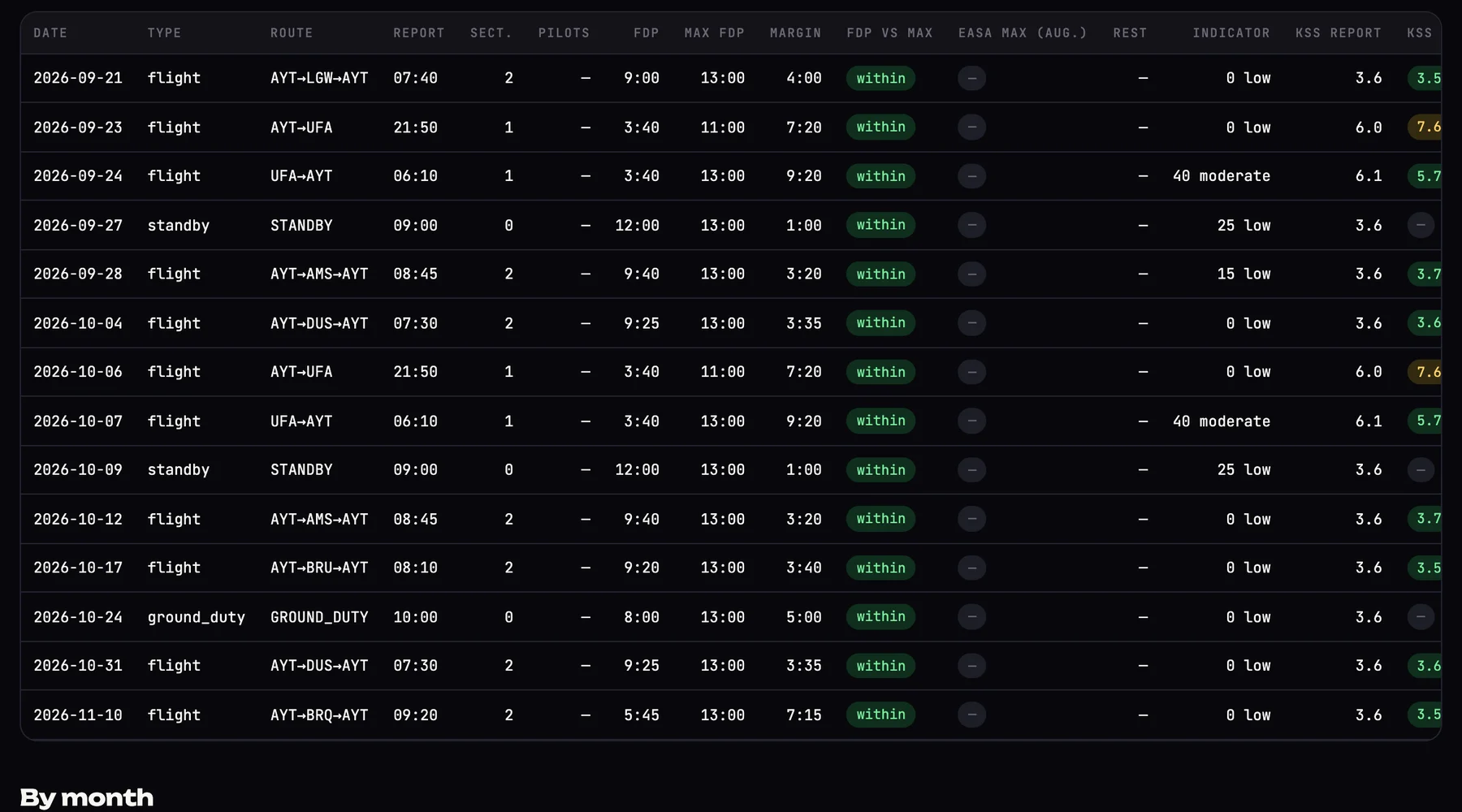
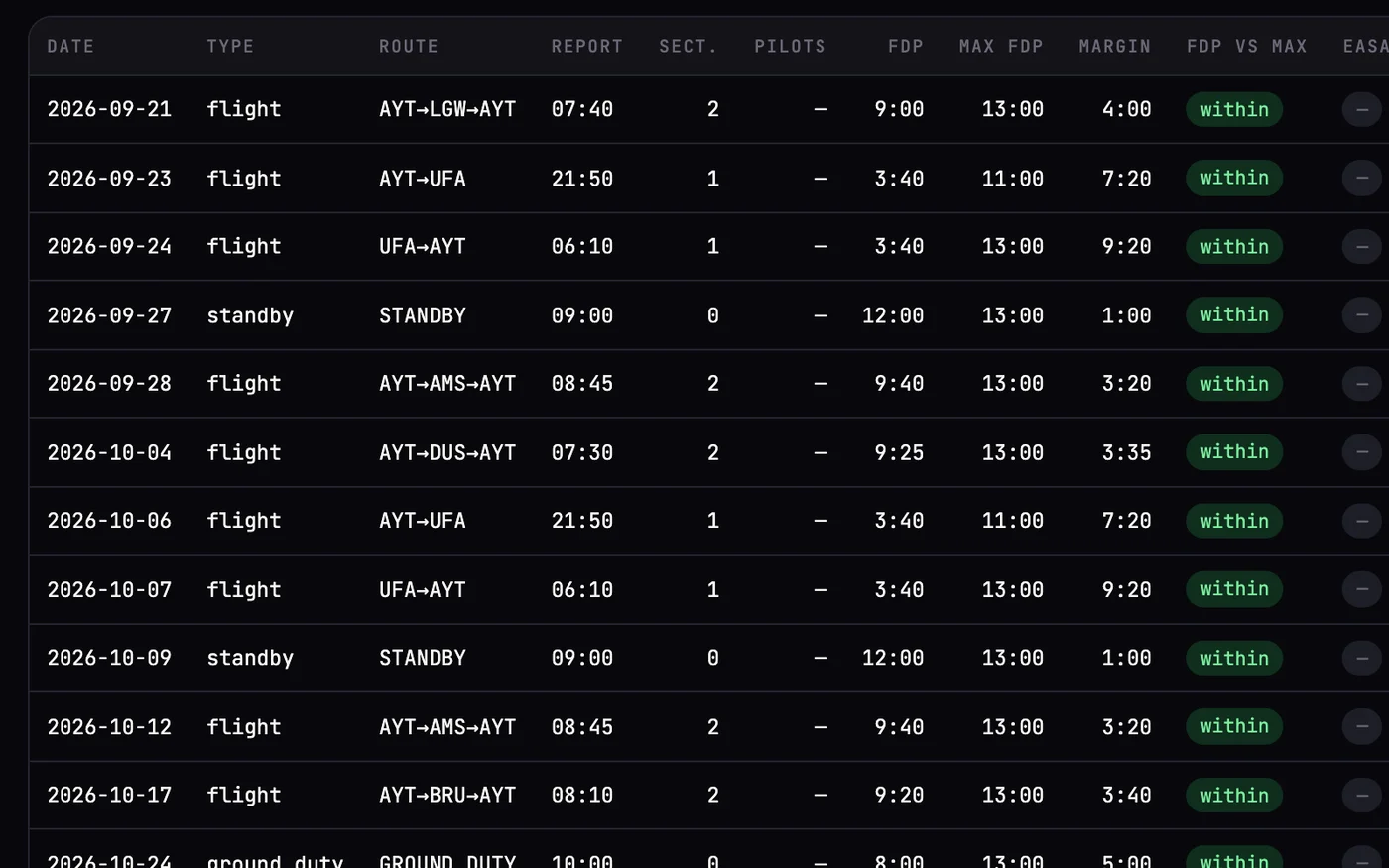
Crewops Insight in the browser on a fictional roster: the duties table with report time, FDP, the maximum in use, the margin and a within label for each duty
A roster assessed before it is flown. 10 seconds, captions and music, fictional airline.
What it shows

What Insight shows

FDP limits cap a duty's length, not alertness at the last landing.

The Crewops Insight duties table for a fictional roster: report time, FDP against the maximum in use, the margin with a within label, the Samn-Perelli-equivalent indicator and the predicted KSS at the top-of-descent stand-in, for flight, standby and ground duties
Fictional roster, read from a calendar file as events: FDP counts from departure, the EASA table gives the maximum. Standby and ground rows are listed but not assessed.

FDP and its margin

FDP is labelled within or over the file's ceiling, else the selected rule set's table (EASA: two-pilot table). With three or four listed pilots and no printed ceiling that table still applies, so a duty inside its CS FTL.1.205(c) maximum, shown beside it, can read over.

In-flight rest

With three or more pilots listed, each pilot's cruise share counts as sleep: the whole slot by default, or a fraction you choose.

Alertness at top of descent

Highest predicted KSS (1 to 9) over a duty's landings, taken 30 minutes before on-blocks by default as a top-of-descent stand-in, with a Samn-Perelli equivalent (KSS minus 2). KSS 7 and Samn-Perelli 5 are EASA FTL 2.0 research markers, not limits.

Night-duty subtypes

Each flight duty is placed in the three subtypes of CS FTL.1.205(a)(3) by report and release time, home-base clock. Starts from 18:00 count as starts at 01:59 or earlier; the last subtype needs a duty of 6 h or more.

Planned against flown

Matches planned and flown exports by date, type, start station and first flight number and compares FDP only, showing the share flown over the maximum beside the 33% level in ORO.FTL.110(j), as complete as your files.

What your crews report

Crew who switch sharing on (off by default, airlines on the ratings programme only) send post-flight Samn-Perelli ratings from the crew app. A rating carries the flight, date, role if known, crew code if entered and a random phone identifier: not anonymous to your operator code, sender not verified, not validated against the prediction.

What goes in

A roster export, read in the browser

Formats

NetLine/Crew PDFs and the 'Activités' rotation workbook (.xlsx). The NetLine reader has been checked on two real PDFs; other layouts have not.

Beta formats

Built from public descriptions or test files, not a real export: Leon, CAE Crew Access, Lufthansa CAS and FLiCA PDFs; AIMS eCrew (page, CSV), CrewConnex and Sabre CWP pages; SkedPlus+; RAIDO/NAVBLUE and FLiCA calendars. Other .ics files are read as events, counted from first departure when they lack a report time. Not listed? Send a sample.

Where it runs

The roster is read in the tab, not uploaded; close it and the analysis is gone. Readers and fonts load from public CDNs; the licence code stays in the browser until sign-out.

What comes out

A CSV with the run's assumptions in each row (not the rule set, home base or version), and the page to print or save as PDF.

The evidence

A published model, limits stated

Read the model card for its assumptions and gaps.

  • The model: Three-Process Model of alertness, with the circadian phase and time-zone adaptation Ingre et al. (2014) estimated on 136 aircrews
  • The sleep: predicted from the duty pattern, not measured; no chronotype or age
  • Checked by tests: KSS conversion, Samn-Perelli pairing, generated-sleep plausibility, augmented-crew limits as transcribed; not compared with published predicted values. FDP tables: secondary sources
  • Not yet done: independent review; line-by-line review of the FDP tables; validation against measured sleep; comparison with another model or crew ratings
Questions

What teams ask first

Is it an FRMS or a fitness check?

No. It supports a fatigue risk assessment, is not an FRMS by itself and makes no fitness-to-fly judgement. Its figures are predictions, not measurements.

What leaves the browser?

The roster stays in the tab. With a licence code, the page sends usage counts and asks our server for your crews' shared ratings. We keep two things: the counts (400 days) and the ratings, which the crew app uploads with the pilot's consent (two years).

Talk to us

Try Insight on your own rosters

Write to us for a trial code and run it on your own roster files in your browser.

Product names belong to their owners; Crewops has no affiliation with them. Regulation references name the rules a feature is built around, not an approval. Your procedures and records prevail.